Thursday, December 12, 2024

Experimental Sculpture Collection


Spiral Fingers (left), White Sun (center), and Connected (right)
Wood, wire, masking tape, paper, ink, hot glue
Largest sculpture is 9.5" x 4" x 8.5"


Connected
Wood, paper, ink, hot glue
9.5" x 4" x 8.5"


White Sun
Wire, paper, wood, ink, masking tape
9" x 3" x 7.5
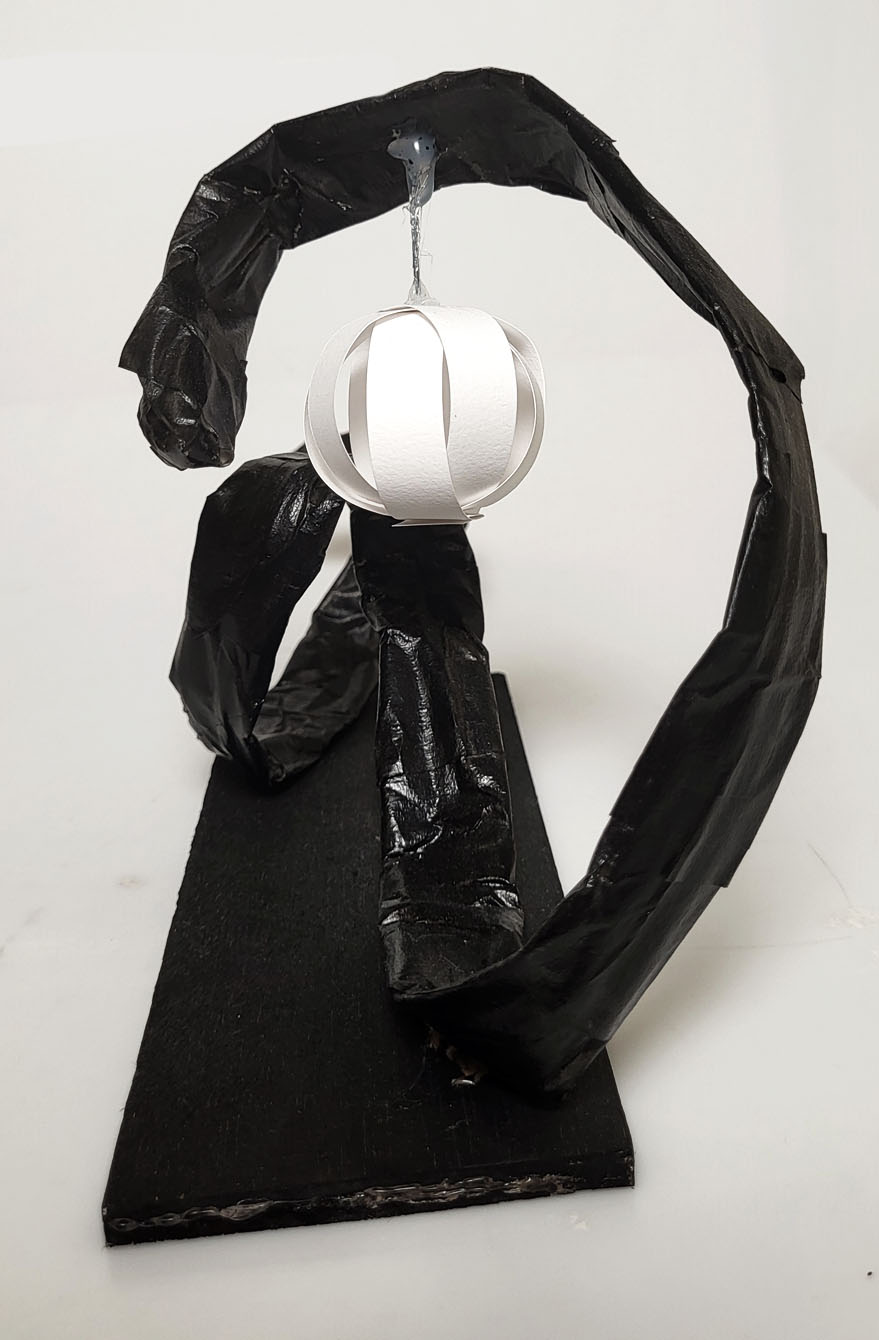


Spiral Fingers
Wire, masking tape, ink, wood, hot glue
8.5" x 3.5" x 3"


In Process


Reflection Statement

The three sculptures visually communicate turning in space. While exploring the materials to build the sculptures, I wanted to focus on creating turns with dynamic shapes and movements while still having them be distinct from each other by designing each around a specific principle of design. Negative space for Connected, focal point for White Sun, and repetition for Spiral Fingers. I wanted to create something that felt like it had movement, or that played with gravity in some way. I decided to include stronger materials like wood to hold things in place and add weight to the sculptures so I could create movement elsewhere while keeping it stable. Little pieces, specifically in Spiral Fingers were not producing the results I wanted, so I simplified and changed the design to something I feel is still visually interesting, but I was able to accomplish. 
I would love to keep exploring creating things with materials like wood and wire as I have never used them before and found using them very interesting. I also want to learn more about how to turn a concept into a physical design, or to be able to translate ideas in my head into something three-dimensional since it is something I don't have a lot of experience with as a 2d artist. These sculptures allowed me to explore just creating and responding to how things were going rather than have to follow something to the letter. Just letting go and being creative. I still feel like I could use some more practice, but this work exposed me to these new ideas that it is okay to create things that aren't perfect or may not work and to be able to learn from and create a better product out of it. It helped expose me to the idea to just start and see where things go rather than trying to plan out everything beforehand. I definitely am going to explore and practice these concepts in my work going forward. 


Crisp-Ellert Artist Talks


Exhibition: Pablo Vindel


Innovations in Art: Devon Schlegel


Sunday, November 10, 2024

Historic Architecture - building photos to talk about in class


The Governors House Cultural Center and Museum


Visual details:

-Darker and natural earthy colors
-Stone weathered texture
-Lots of windows with detailing (rectangular and repetitive)

History 

This historic site has served the city of St. Augustine since 1598. This site served as the administrative headquarters and residences for colonial governors appointed by Spain, then Britain, and then Spain again. In 1821 when Spain ceded Florida to the U.S., the Government House building was used as a courthouse and briefly as the Capitol building of the new Territory of Florida. 


Lightner Museum


Visual details 

- smooth Stone texture with intricate detailing at top and around windows
- arches / brick-like texture around windows
- detailing on archway and a lot of repetitive small widows

History 

The Lightner Museum is housed in the former Alcazar Hotel, built in 1888 by Henry Flagler. It opened to the public in 1948 after the hotel was purchased by Otto Lightner to house his collections. The building was initially conceived as a recreational entertainment annex for the grander Hotel Ponce de Leon, but the design was soon revised and expanded to create an independent hotel


Memorial Presbyterian Church


Visual details

- spires / pillars (virticle lines) 
- extreme detail (like doors and windows) on a smooth flat background 
Half circles around windows and detailing under archway 
Courtyard and detailed brick flooring 

History

Memorial Presbyterian Church in St. Augustine was the first Presbyterian congregation in Florida and was first constructed in 1830. The present Memorial Presbyterian Church was built by Henry Flagler in memory of his daughter, Jennie Flagler Benedict, who died tragically in 1889. He presented the Venetian Renaissance style structure to the First Presbyterian Church. Upon moving into the new building in 1890, the congregation took the name Memorial Presbyterian Church in honor of their benefactor. 

Tuesday, November 5, 2024

Dinner and a Movie


Bittersweet
Digital Photograph
Inspired by the movie A Man Called Otto (2022)


This photograph reflects the themes of grief, time and nostalgia, along with idea that in order to start to move on it has to be through actions to reach out to those around you and make the most of what you still have. The living rose next to the dead rose on the plate symbolizes a romance that has been torn apart by loss, and the grayscale color palate around the plate adds contrast against the vibrant colors on the other side of the table representing family and youth. The layout of the photo was set to portrait to help convey these themes since the elements outside of the plate set-up are much further away than if the image were laid out as a landscape. If you were sitting at this table and this was your plate, it would take a conscious act of reaching out to have what else is on the table. The watch adds to this because you would be reaching over the watch, symbolizing being stuck in the past and having to reach past that to move on. The image conveys how grief can be all consuming to the individual, making it hard to reach out and see the good things in life that you have left. Letting people in, reaching out for help, and moving on can seem almost impossible. The knives boxing in the plate along with a square fabric under the plate symbolizes the walls that can be put up and how hard it can be to get through those defenses to other people trying to help. The more childish elements like the drawing, cookies, and crayons to represent both family, nostalgia and childhood, with one cookie much closer to the plate, symbolizing someone reaching out through sharing. An offering of help and the chance to look past the grief and see good in the world around you.


April 10

 New work (+ in progress)  Artist Reflection  For this week I continued to develop my work. I started to add further detail with a dip pen a...